Unwrapped: The Case for Handing an Orchid Over in Open Air
Photo: (c) Fabien Anthelme, some rights reserved (CC BY-SA), CC BY-SA 4.0, via Wikimedia Commons
There is a moment, familiar to anyone who has sent flowers in Britain, when a gift is carried up a wet garden path in a haze of crinkled polythene. The sleeve is meant to say that the sender cared. What it more often says, on a November afternoon, is that nobody has thought about what happens between the shop door and the recipient's kitchen table.
This is an argument, from behind the counter, for taking the orchid out of its packaging before it is handed over.
What a sealed sleeve actually does
Cellophane performs three functions. It keeps a bouquet from brushing against doorframes. It suggests, in the absence of better ideas, that something has been gift-wrapped. And it holds a small, humid microclimate around a living plant.
The first is useful for cut flowers, which have no future to protect. The second is a matter of taste. The third is the problem.
An orchid in bud, sleeved at nine in the morning, sitting in a warm van and then carried into a cold porch, will condense water on the inside of the plastic within minutes. Those droplets settle on the flowers. Buds soften. Petals mark. By the time the sleeve comes off in a warm hallway, the damage has already happened, and the sender will never know why the flowers fell within three days.
The damp British weather problem
Our climate is unusually good at producing condensation. Cold air outside, warm air inside, a plastic film between the two, and a plant that is already transpiring. Add a paper collar, which absorbs the moisture and holds it against the stem, and you have created the conditions in which botrytis thrives.
There is a second issue, which few customers consider. A sealed sleeve traps ethylene, the gas produced by ripening fruit, cigarette smoke, and the general fug of a busy household at Christmas. Ethylene is the single most reliable cause of bud drop in orchids. A plant that arrives sealed, and is then placed on a sideboard next to a bowl of satsumas, has been dealt two blows before it has been unwrapped.
The elegance question
Beyond horticulture, there is the matter of how a gift should look at the moment it is given. Cellophane has a sound and a shine that belong to garage forecourts and supermarket bunches. It obscures the very thing that justifies the price of an orchid: the shape of the leaves, the structure of the stem, the colour of the pot.
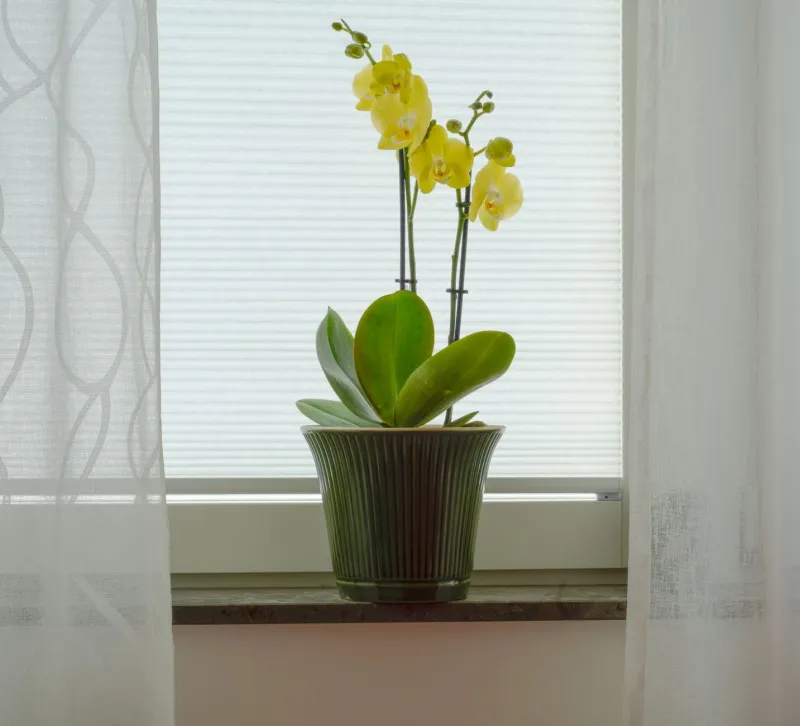
An orchid presented bare, with its own pot and its own stake, is a more confident gift. Nothing is being hidden.
The open handover, step by step
What we would propose instead is simple, and costs the trade very little.
- Agree a time. A handover at the door, rather than a bag left on a step in the rain, is worth arranging in advance.
- Unwrap before presenting. The florist removes the sleeve at the door or in the porch, checks the plant, and hands it over as an object rather than a parcel.
- Use a paper collar, not a sleeve. A corrugated paper collar fitted around the pot protects the compost and the base of the stem while leaving the flowers entirely in the open air.
- Tie with paper twine or raffia. It holds the collar, protects nothing that needs protecting, and can go into the recycling with the card.
- Hand over the care card separately. More on this below.
- For courier deliveries, use an open-topped kraft wrap. A box with a moisture-resistant base and no lid allows air to move while still shielding the stem from knocks.
The care card belongs in the hand, not the bin
Most orchids arrive with a printed label that says, in four languages, to water once a week. It is stuck to the pot and removed within a day.
A care card, handed over at the door with two or three lines written by the person who prepared the plant, survives. It might say where the plant was grown, what temperature suits it, and how the recipient should judge when to water. It takes a minute to write and it changes the fate of the plant. It also transforms the delivery from a transaction into an act of advice, which is what a florist is for.
Carrying it home without a sleeve
Recipients often ask how to move an orchid safely, particularly in December when cars are cold and boots are full.
Carry the plant by the pot, with both hands beneath it, never by the stem. A deep-sided box with a folded towel in the base will hold it upright on a back seat. Do not put it in the boot, where it will slide and chill. Do not rest it on a passenger's lap with a seatbelt across the flowers. And if the journey is more than a few minutes in freezing weather, wrap the pot, not the flowers.
What we would ask of the trade
Sleeves persist because they are cheap, quick and expected. Breaking the habit requires florists to explain, briefly and without lecturing, why an open plant travels better and looks better on arrival.
In 2026 that explanation is easier to make than it has ever been. Customers are already suspicious of excess packaging, already aware of what damp does to paper, already inclined to think that a living plant deserves better than a plastic film. The argument does not need to be won so much as made.
An orchid is not a bouquet. It has a future, and the way it is handed over is the first indication of whether anyone has thought about that future. Present it in the open air, with a card and a collar, and the gift begins properly at the doorstep rather than a week later, when the last bud falls.