Before the Gates Close: Teacher Orchids for the Autumn Term’s Final Morning

Photo: Internet Archive Book Images, No restrictions, via Wikimedia Commons
The last day of the autumn term has a particular texture in British schools: car engines idling, wrapped boxes balanced on knees, children rehearsing a card in the back seat, and a reception desk steadily disappearing beneath chocolates, biscuits and miniature bottles of prosecco. In the middle of this goodwill, a potted orchid can look remarkably considered — provided it is chosen for the journey as well as the gesture. The aim is not to outshine the pile of chocolate boxes, but to offer something calm, lasting and genuinely suited to a classroom in December 2026.
Why an orchid earns its place beside the chocolates
A good orchid gift does not ask the teacher to do very much on the final afternoon. It arrives with its own composure. Unlike cut flowers, it does not need a vase; unlike a hamper, it does not need to be carried home in several parts. A compact phalaenopsis in a secure pot can sit on a desk, be admired, and then be taken home without becoming another item on a long to-do list.
There is also the question of endurance. A teacher may receive several boxes of confectionery, most of which will be shared in the staffroom before the holidays. A plant has a longer arc. It can remain in the classroom for a few days, move to a kitchen windowsill, and continue flowering well into the new year if it is given reasonable light and restrained watering. For parents and carers who want a gift that feels more enduring than a novelty tin, that is a fair advantage.
The florist’s caveat is simple: choose the right orchid. A tall, top-heavy specimen may look magnificent in a shop window and thoroughly awkward in a crowded school corridor. The best teacher orchid is compact, well-rooted, securely potted and easy to carry upright.
Compact varieties that travel without drama
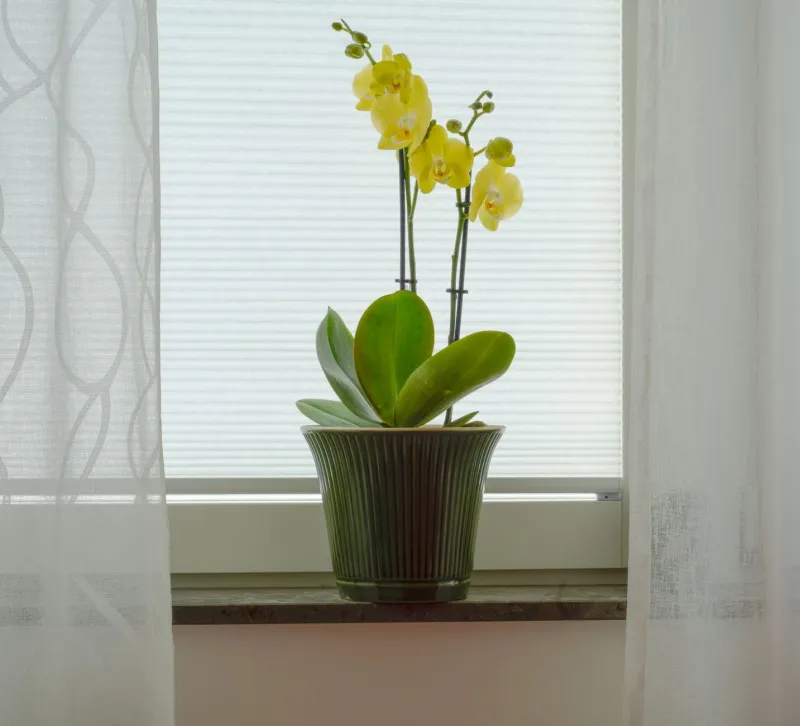
For the school run, mini phalaenopsis orchids are the safest and most practical choice. A 9cm or 12cm pot with a short, supported stem is easy to place on a passenger seat floor, in a footwell, or on the back seat beside a responsible child. Avoid very tall stems, loose decorative moss and pots that taper at the base; they are more likely to tip when the car door opens and the school bag is hauled across the seat.
A florist can pack a potted orchid in a sturdy box or sleeve with a flat base. This is not excessive packaging; it is what stops the plant from sliding across the boot. If you are collecting in person, ask for the orchid to be packed upright and keep it out of the boot if possible. A car can become surprisingly warm even on a cold December morning, and a plant left in a heated car during a lengthy assembly will not thank you.
Colour is a matter of taste, but neutral whites, soft pinks and pale greens tend to suit staffroom tables and home interiors alike. Avoid glitter, elaborate ribbons and strongly scented additions. The orchid should look elegant on its own, not like a Christmas decoration that has wandered into the wrong season.
A fair chance in the classroom over Christmas
A school classroom is not an ideal orchid habitat: it may be warm, brightly lit by fluorescent strips, draughty at the windows, and empty for a fortnight. The gift’s best chance lies in a short stay followed by a journey home. It is worth choosing an orchid in bud or partly open, rather than one in full, exhausted bloom. Buds travel better and give the teacher something to watch over the break.
A small care card is more useful than a long explanation. Keep it to three points: bright, indirect light; water sparingly, allowing the compost to dry slightly; and keep away from radiators and direct sun. If the teacher is likely to leave the plant in the classroom over the holidays, a brief note suggesting it goes home before the cleaners arrive is practical rather than presumptuous.
Parents should also resist the urge to add decorative stones, water globes or unsuitable containers at the last minute. A well-grown orchid in its original pot, with a simple cachepot if desired, is easier to care for and less likely to suffer from overwatering.
Timing, delivery and the school office
The final morning is not the moment for a courier to be finding the school reception for the first time. If ordering for delivery, aim for one or two working days before the last day of term. Confirm that the school office accepts deliveries, check its opening hours, and avoid the half-hour around assembly or the end-of-term performance. A named recipient and a clear label matter more than a dramatic arrival.
For group gifts, one delivery is kinder to the office than twenty separate ones. Collect contributions in advance, order a single plant or a small arrangement, and attach one card signed by the families involved. If you are handing the orchid over yourself, give it to reception rather than sending it into the classroom in a child’s bag. A plant carried sideways in a backpack has already lost the argument.
Term dates vary across the UK, so check the school calendar rather than relying on memory. In 2026, some schools break earlier than others, and a gift that arrives after the gates have closed is simply a gift that has missed its occasion. If the last day is uncertain, a florist can usually schedule delivery for the penultimate morning, which is often calmer for everyone.
Budgets that read as considered
A thoughtful teacher orchid does not require a large spend. A mini phalaenopsis in a simple pot is usually a modest purchase and can look charming with a handwritten card. A larger pot, a ceramic cachepot or a grouped arrangement raises the budget and the visual presence, but it should still feel appropriate rather than extravagant. For a class collection, a single generous plant with a joint card is often more graceful than a dozen small gifts competing for space.
The florist’s advice is to spend on condition rather than decoration. Firm leaves, healthy roots and a secure pot matter more than ribbon. Ask how long the orchid has been in bloom, whether the stem is supported, and how it should be carried. A considered gift is one that has been thought through at the point of purchase, not merely at the point of giving.
Words that avoid the usual script
Enclosure cards are where teacher gifts often go wrong. Phrases such as ‘best teacher ever’ and ‘thank you for helping me bloom’ are well meant, but they have been printed on so many cards that they can feel impersonal. A short, specific message is more affecting. For example: ‘Thank you for your patience with [child] this term. We hope this orchid gives you a quiet spot over the holidays.’ Or: ‘For the end of a long term — with thanks from our family.’ For a class gift: ‘With thanks from all the families in [class]. We hope you enjoy a restful break.’
Include the teacher’s name, the child’s name and, if appropriate, the class. Avoid jokes about marking, wine or escape. Keep the tone warm but measured. The orchid itself is already a gesture; the card need only confirm who it is from and why.
A final check before you pay
Before leaving the shop, confirm that the pot is stable, the stem is supported and the plant is not sitting in water. Ask for a care card if one is not supplied. If the gift is for a teacher with a known allergy or a strongly scented classroom policy, a low-scent orchid is usually the safer choice. And if the school has a gifts policy, respect it; a small plant delivered to the office is rarely a problem, but a grand display might be.
The last day of term will always be busy. A compact orchid, ordered in good time and packed to travel, will not add to the commotion. It will simply arrive looking as though someone thought about the teacher, the classroom and the journey home — which is, after all, the point.