The Quiet Between: Orchid Care from Boxing Day to New Year's Eve
The week between Boxing Day and New Year's Eve has its own rhythm. The main meal is behind us, the refrigerator is still full, and the house is neither quite in holiday mode nor back in ordinary order. Visitors arrive at odd hours, the heating is often left running, and the usual weekday structure dissolves. For an orchid received as a Christmas gift, this is a vulnerable interval. It is not a crisis, but it is a period when small changes in the room can add up. The aim is simple: keep the plant steady through the quiet between, so that it begins the new year in good condition rather than in need of rescue.
The Room Has Changed, Even If the Orchid Has Not
A festive room is rarely the room an orchid would choose. Central heating may be on for longer, and a radiator that was once cool can become a source of dry, moving air. Guests may place coats, bags or wrapping paper on windowsills, crowding plants that were previously undisturbed. A temporary Christmas table arrangement can end up beside a potted orchid, creating a dense cluster where air does not move freely. None of this is unusual, but it is worth noticing. Orchids dislike abrupt changes in temperature and humidity more than they dislike an imperfect position. The practical response is not to move the plant repeatedly, but to make one considered adjustment and then leave it alone.
Begin by checking the immediate surroundings. Is the orchid sitting directly above a radiator, or within the path of a fan-assisted heater? Is it pressed against a window that is cold at night and bright at midday? A metre or so away from a heat source is often enough to reduce stress without removing the plant from good light. If the room is filled with guests and the air feels dry, a simple saucer of water placed nearby—not beneath the pot—can help slightly, though it is not a substitute for sensible placement.
Watering by Observation, Not by the Calendar
The holiday period disrupts watering routines as much as it disrupts everything else. An orchid that is watered on a fixed day each week may be overlooked during a houseful of visitors, or overwatered by a well-meaning guest who notices the compost looks dry. Moth orchids, the most common gift orchid, are usually better served by observation than by schedule. Check the roots visible through the pot: silvery or pale roots suggest the plant is ready for water, while green roots indicate that moisture is still present. The surface of the compost can be misleading, especially in a warm room where it dries quickly while the centre remains damp.
If the orchid is in a decorative outer pot, lift the inner pot and check that no water is standing in the base. This is especially important after Christmas, when plants are often moved to make room for serving dishes or decorations, and a pot may be set down on a saucer that is already wet. One thorough watering, allowed to drain completely, is preferable to several small additions. In the quiet between, it is better to err on the side of slightly dry than to leave the roots sitting in moisture for days.
Light, Draughts and the Trouble with the Sill
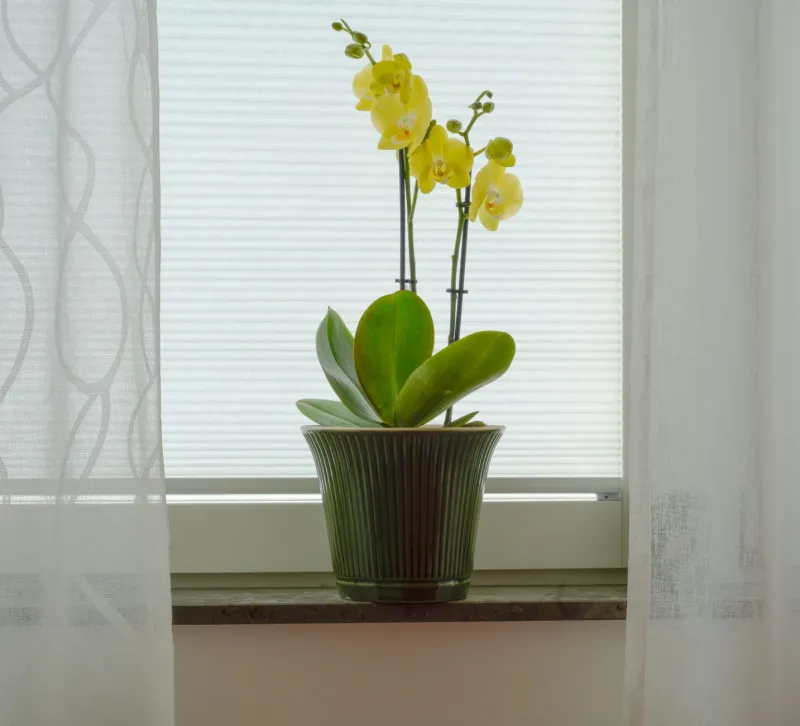
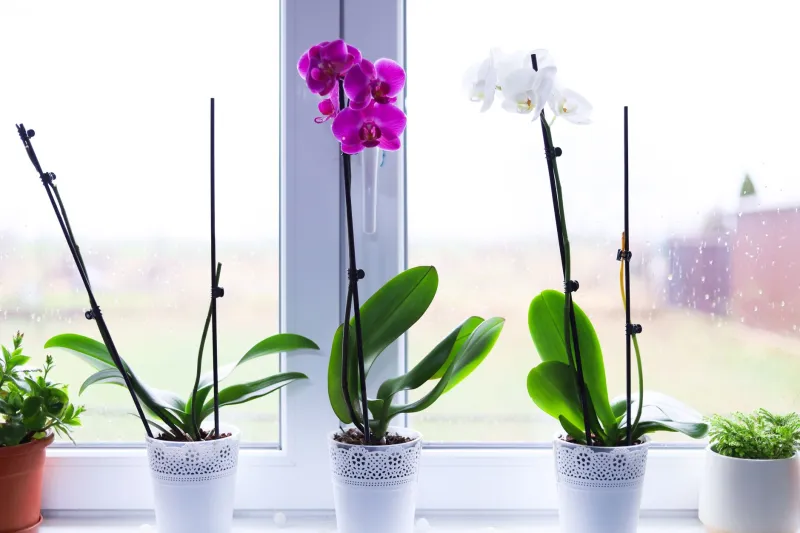
British winters offer limited light, and a windowsill is often the brightest place in the house. It is also the coldest at night and the most likely to be draughty. An orchid placed on a sill behind closed curtains can be exposed to a sharp drop in temperature after dark, particularly during a cold snap. If the plant must stay near the window, closing the curtains between the pot and the glass—or moving the orchid to a nearby table for the night—will reduce the risk. East- or west-facing positions are generally kinder than a south-facing sill in a heated room, where midday sun can be surprisingly strong even in December.
Draughts are equally important. A door that is opened repeatedly for visitors, or a chimney that draws air through a room, can create a steady current that dries leaves and buds. The orchid does not need to be sealed away, but it should not sit in the path of a regular draught. A position slightly back from the window, away from radiators and doorways, is usually the most stable compromise.
Relocating a Gifted Orchid Without Shock
Many orchids arrive during the Christmas period in temporary wrapping or a decorative pot. By the quiet between, the wrapping may be looking tired, and the plant may need to be moved to a more suitable place. When relocating, handle the pot rather than the stem, and support any tall flower spikes. Avoid repotting now unless there is an obvious problem such as waterlogged compost or a damaged pot. Repotting is best left until spring, when the plant has more energy to recover. If the orchid was a gift for a household rather than for an individual, it is worth agreeing on one person who will check it, so that care does not become a series of conflicting instructions.
A Short January Set-Up
The final days of December are a good time to make a few small preparations for the year ahead. Remove any faded flowers and check the leaves for dust, which can be wiped gently with a soft, damp cloth. Confirm that the orchid is not sitting in water, and that it has a stable position with reasonable light. If the plant came with a care label, keep it somewhere visible; if it did not, a short note on watering and position can help everyone in the household. These steps are modest, but they set the orchid up for January, when the house returns to its usual temperature and the plant must adapt again.
The quiet between Christmas and New Year is not a time for elaborate intervention. It is a time for observation, for small adjustments, and for resisting the urge to fuss. An orchid that is kept steady through this interval—neither too wet nor too dry, neither too hot nor too cold—will be better placed to flourish when ordinary life resumes.